Context
Smallpox was one of the deadliest diseases in human history, killing roughly 30% of those infected. In the 20th century alone it killed an estimated 300 million people. Survivors were often left blind or severely scarred. It had devastated civilizations for millennia, from ancient Egypt to the Aztec Empire.
The Deed
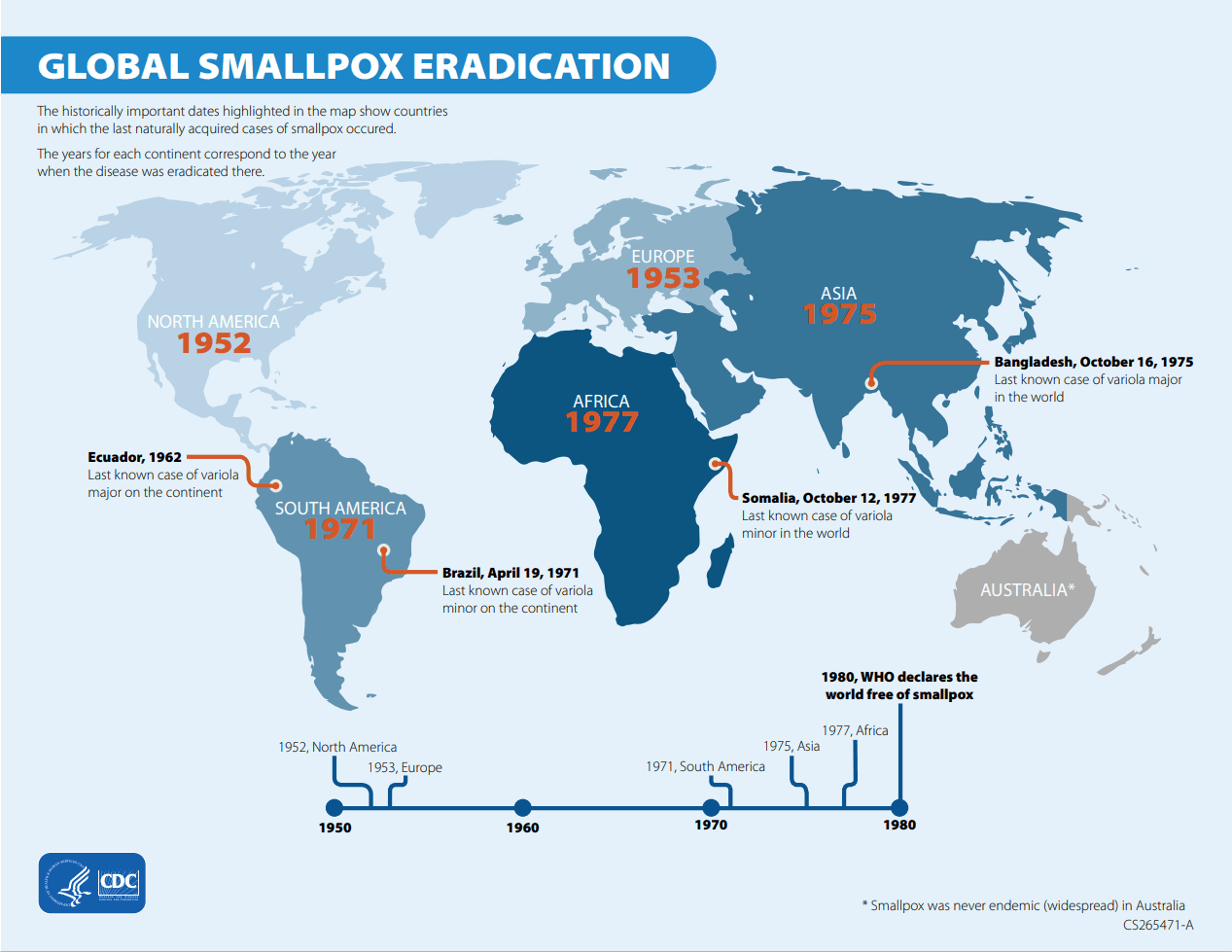
Jenner's 1796 experiment, inoculating a boy with cowpox and proving immunity to smallpox, established the principle of vaccination. The WHO's 1967 intensified eradication campaign, led by D.A. Henderson, deployed ring vaccination, aggressive surveillance, and containment. Workers tracked cases village by village across Africa and Asia. The last natural case occurred in Ali Maow Maalin, a hospital cook in Merka, Somalia, on October 26, 1977.
Why It Matters
It remains the only human disease ever deliberately eradicated. It proved that international cooperation, even during the Cold War, could achieve what no nation could accomplish alone. The eradication saves an estimated 5 million lives every year that would otherwise be lost.
Brutal Truth
The campaign often employed coercive tactics. In some areas, vaccination teams physically restrained resisters. The Soviet Union and the United States cooperated on eradication while pointing nuclear weapons at each other. Samples of the virus still exist in two laboratories, an ongoing biosecurity concern.
By the Numbers
- 300 million killed in the 20th century alone
- 5 million lives saved per year since eradication
- The campaign cost $300 million over 11 years
- 10 years from campaign launch to last natural case